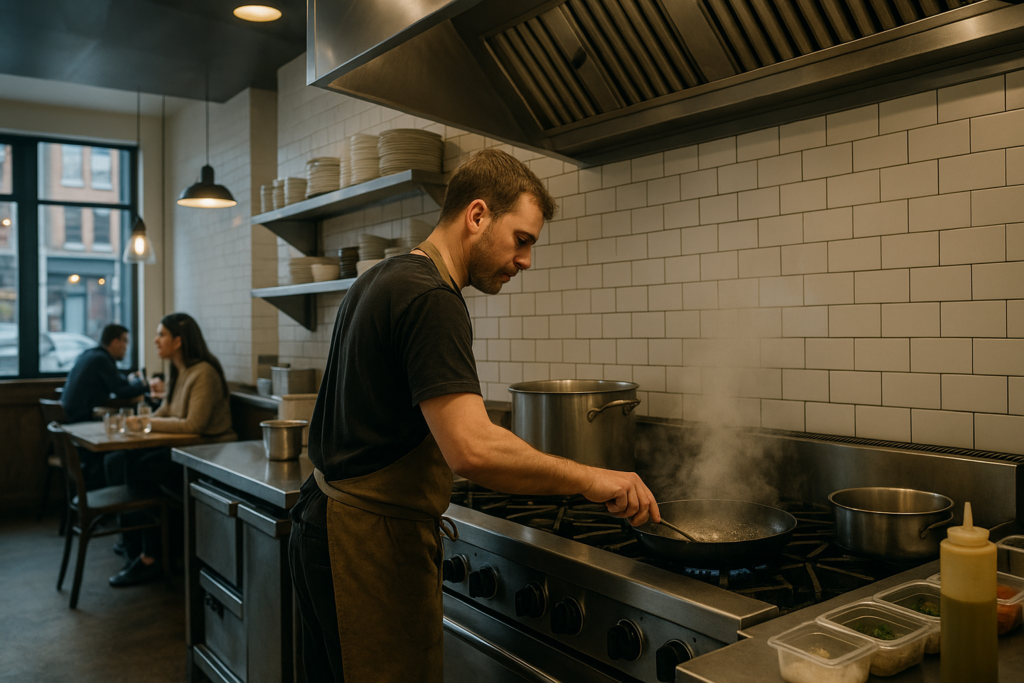
Walk down any busy street in Toronto, Mississauga, or Hamilton and you’ll notice something: the restaurants with lineups aren’t always the ones with the best food. They’re the ones people can find, trust, and talk about online. That’s the reality of Canadian restaurant marketing right now. If your business doesn’t show up where people are searching, you’re invisible — no matter how good the kitchen is.
What Canadian Restaurant Marketing Means for Your Business
Most restaurant owners think “marketing” means running ads or posting on Instagram. It’s bigger than that. Your online presence is your storefront window at 11pm when someone is deciding where to eat tomorrow. If that window is dark, they walk past.
Here’s what that window actually includes:
- Your Google Business Profile — the first thing people see in search
- Your website, even if it’s simple
- Your reviews on Google, Yelp, and TripAdvisor
- Your social media activity — or lack of it
- How your restaurant appears on delivery platforms like DoorDash or Uber Eats
Each of these touchpoints either builds trust or erodes it. A restaurant with 12 Google reviews and a phone number that goes to voicemail signals something to customers — and not something good.
The good news? Most independent restaurants in Canada are still doing this poorly. That means there’s real room to stand out without a massive budget.
Common Mistakes That Kill Your Online Visibility
Before talking about what to do, it’s worth naming what’s getting in the way.
Ignoring your Google Business Profile. This is the single highest-impact free tool available to any local restaurant. And yet most owners set it up once and forget it. Hours change, photos get stale, and no one responds to reviews. Google notices this. So do customers.
Posting on social media without a strategy. Random photos of your specials, posted whenever someone remembers, don’t build an audience. They just create noise. Consistency and context matter far more than frequency.
Assuming a website is optional. Some owners believe a strong Instagram is enough. It isn’t. A basic, mobile-friendly website with your menu, location, hours, and a way to book or order is still essential. Google can’t rank a social media profile the same way it ranks a website.
Not asking for reviews. Most happy customers won’t leave a review unless you ask. It feels awkward to ask, so owners don’t. Meanwhile, the one unhappy customer always finds time to write a paragraph. You have to actively manage this.
How It Works in Practice
Let’s look at what this actually looks like when restaurants take it seriously.
A Brunch Spot in the East End
A small brunch restaurant in Toronto’s east end was doing steady weekend business but slow during the week. The owner assumed weekday traffic was just “how brunch spots work.” After a proper audit, the problem was clear: their Google Business Profile showed no weekday hours, their website hadn’t been updated in two years, and they had fewer than 30 Google reviews despite being open for five years.
They updated their profile, added weekday lunch photos, responded to every existing review, and started asking regulars to leave feedback. Within three months, weekday reservations increased noticeably. Nothing changed in the restaurant itself — just how it appeared online.
A Family-Run Indian Restaurant in Mississauga
A family-owned restaurant was getting outranked by a chain location nearby, despite having better reviews. The issue wasn’t the reviews — it was the website. No location keywords, no embedded map, no structured menu content. A modest investment in local SEO fixes — not a full redesign — helped them appear in the top three local results for relevant searches within about 90 days.
A Pub in Downtown Hamilton
This owner was skeptical of social media. He’d tried it, posted a few times, and seen nothing happen. The real issue wasn’t social media itself — it was that his posts had no call to action, no consistency, and no local targeting. After switching to a simple two-posts-per-week rhythm with event promotions and behind-the-scenes content, his Thursday trivia nights went from half-empty to sold out over one season.
Each of these situations followed the same pattern: small, targeted changes to how the restaurant showed up online — not reinvention, just repair and intention.
What to Do Instead of Guessing
Here’s a contrarian point worth sitting with: more content is not the answer. Most restaurants don’t need more posts, more platforms, or more promotions. They need fewer things done properly.
Start with your Google Business Profile. According to Google Business, businesses with complete and regularly updated profiles are significantly more likely to receive customer actions like direction requests and website visits. Get the basics right first.
Then look at your reviews. A steady flow of recent, positive reviews does more for local search ranking than almost anything else. It also builds social proof that converts hesitant customers.
After that, evaluate your website. It doesn’t need to be beautiful. It needs to be fast, mobile-friendly, and clear. Menu, location, hours, contact. That’s the floor.
Social media comes last — not because it doesn’t matter, but because it matters less than getting found in the first place. HubSpot’s marketing research consistently shows that search and reviews drive purchase decisions in the food and hospitality space more than social discovery.
One important nuance: this advice applies most to restaurants trying to attract new local customers. If your restaurant relies primarily on events, catering, or a loyal repeat base, the priorities shift. Social media and email lists matter more in those cases. Know what you’re actually trying to build.
Where to Start With Canadian Restaurant Marketing
If you’re overwhelmed by all of this, narrow it down to three actions this week.
First, log into your Google Business Profile and verify that your hours, phone number, photos, and description are current and accurate. This takes under an hour and has immediate impact.
Second, pick two or three recent customers you know personally and ask them — by text or in person — to leave you a Google review. Don’t send a mass blast. Make it personal.
Third, open your website on your phone. If it’s slow, hard to read, or the menu is buried in a PDF, flag it as something to fix this month. A bad mobile experience is quietly costing you reservations.
These aren’t complicated. They don’t require an agency or a big budget. But they do require follow-through — which is exactly where most independent operators stall out.
Canadian restaurant marketing doesn’t have to be expensive. It has to be consistent and intentional. The restaurants winning in local search right now aren’t outspending anyone. They’re just showing up properly while their competitors ignore the basics.
At Sonamax Marketing Group, we work with Toronto-area restaurant owners who are tired of guessing. We audit what’s actually holding you back online and build a plan that fits how your business actually runs — not a template someone copied from a blog. If you want a straightforward look at where your online presence stands, let’s talk.