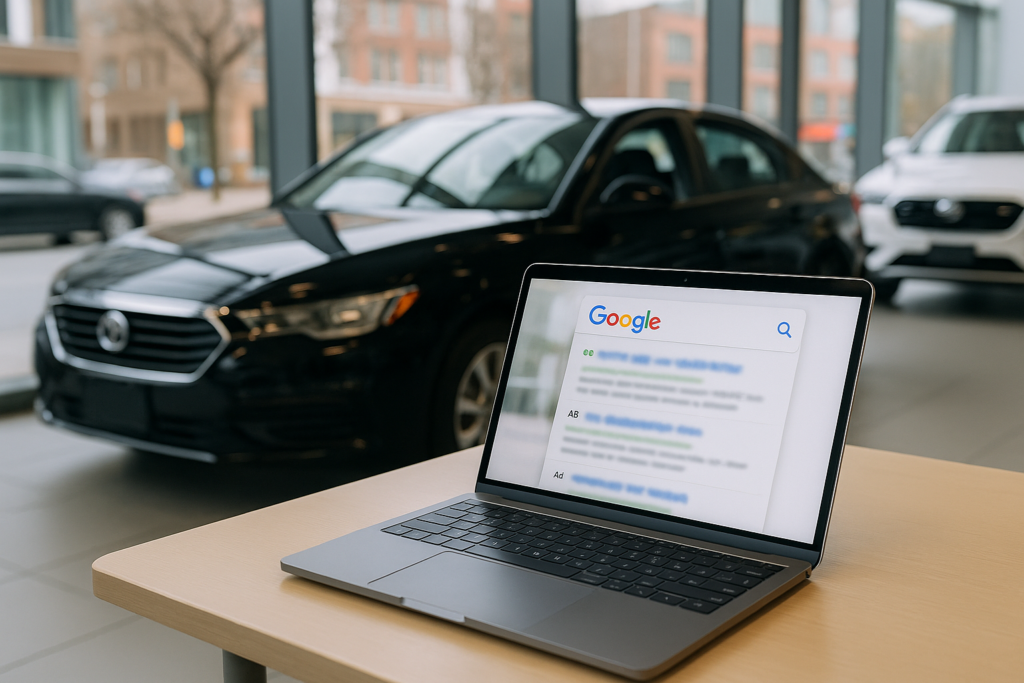
A shopper in Etobicoke types “used SUV under 25k near me” into their phone at 9pm on a Tuesday. Whoever shows up first, with the right car and a clear price, usually wins that lead. That single moment is the whole game when it comes to car dealership Google Ads Toronto, and most dealers are losing it before they even realize the auction happened. This is part of our broader guide on How Small Businesses Turn Ad Spend Into Leads. For the full overview, see How Small Businesses Turn Ad Spend Into Leads.
I’ve sat across from dealership owners who spend more on their coffee machine than they do thinking about how their ads actually convert. They pour money into Google, see a bit of traffic, and assume it’s working. Then the month closes and the sales team can’t point to a single deal that came from it. The problem is rarely the platform. It’s how the campaigns are built and what they’re pointed at.
Why Car Dealership Google Ads Toronto Works Differently Than Retail
Selling a vehicle is not selling a pair of shoes. A car is a considered purchase, often the second-biggest one a person makes. Someone might research for six weeks before they walk onto a lot. That means your ads have to catch people at very different stages, and treating every click the same is where budgets bleed out.
The Toronto market adds its own wrinkle. You’re not competing with the dealer down the street. You’re competing with every dealer across the GTA who ships cars, plus the big online used-car platforms with deep pockets. A buyer in Leslieville will happily drive to Mississauga for the right price. So your geographic targeting and your inventory strategy have to be sharper than a dealer in a small town would ever need.
There’s also the trust factor. People are wary of dealerships by default. Your ads and landing pages need to feel honest fast. Real prices, real photos, real availability. The dealers who hide the price to force a phone call are watching their cost per lead climb every quarter.
The Campaign Types That Actually Move Metal
Google gives you a lot of options, and not all of them earn their keep for a dealership. In my experience, three campaign types do the heavy lifting, and the rest are situational at best.
Search campaigns are your foundation. When someone types a specific make and model, they have real intent. Those searches are worth paying for. Vehicle ads, Google’s inventory-based format, are the sleeper hit for used-car dealers. They pull your live inventory into the search results with photos and prices, and they tend to produce a lower cost per lead than plain text ads. Performance Max can work, but it’s a black box, and I’ve seen it quietly burn spend on low-value clicks when it’s left unsupervised.
Here’s a rough breakdown of how I’d split a starting budget for a mid-size used-car dealership:
- Search (branded + model-specific): 45% of budget
- Vehicle ads / inventory campaigns: 35% of budget
- Performance Max (tightly monitored): 15% of budget
- Remarketing to site visitors: 5% of budget
Those numbers aren’t gospel. They shift based on your inventory size and how strong your brand searches already are. But if you’re putting 80% into one campaign type, something’s off.
The Contrarian Truth About Bidding on Your Own Brand
Most dealers hate the idea of paying for clicks on their own dealership name. “People already know us, why pay for that click?” It feels like buying something you’d get for free. I understand the instinct, and I still tell almost every dealer to do it.
The reason is simple. If you don’t bid on your name, a competitor or an aggregator will. When a customer who’s ready to buy from you searches your dealership, the last thing you want is a rival’s ad sitting above your organic listing. Branded clicks are cheap. Losing a bottom-of-funnel buyer to a competitor’s ad is expensive. Think of it as insurance on the customers you’ve already earned.
That said, I won’t pretend branded search alone builds a business. It captures demand you already created. It doesn’t create new demand. If your branded spend is your biggest line item, you’re defending a castle without expanding the kingdom.
Three Dealers, Three Real Outcomes
A used-car dealer in Rexdale came to us running a single catch-all search campaign. Everything went to one landing page. We split the account by vehicle type, built inventory-based vehicle ads, and sent each ad to the exact car it advertised. Within about four months, their cost per lead dropped roughly a third, and the sales floor could finally trace test drives back to specific campaigns.
Then there was a family-owned dealership in the Junction that only sold higher-end used sedans. They wanted volume, so they’d cast a wide net on cheap-car keywords. The clicks came, the leads didn’t close. We cut the low-intent keywords entirely and focused the budget on model-specific searches that matched their actual inventory. Lead volume dropped by half. Closed deals went up. Their monthly ad-to-sale ratio improved to the point where they added a second GTA location within a year.
A newer dealer in Brampton had a different issue. Good campaigns, terrible follow-up. Leads came in and sat in an inbox for hours. We didn’t touch the ads much. We fixed the response time with automated alerts and a simple booking link in the ad extensions. Their lead-to-appointment rate climbed noticeably in six weeks. Sometimes the ads aren’t the problem at all.
Where Dealership Budgets Quietly Disappear
The biggest money leak I see is broad match keywords with no negative list. Broad match will happily match your ad to “how to fix a transmission” or “car rental Toronto.” You pay for those clicks, and none of them want to buy a car from you. A tight negative keyword list is unglamorous work, but it’s the difference between a lean account and a leaky one.
The second leak is sending every click to your homepage. A homepage is a lobby, not a sales pitch. If someone clicks an ad for a specific truck, they should land on that truck’s page, price visible, financing options right there. Every extra click you force costs you buyers. This same principle burns service businesses too, which is why it comes up in our breakdown of what service businesses should know before spending a dollar on Google Ads.
Third, there’s conversion tracking, or the lack of it. If you can’t tell Google which clicks became phone calls, form fills, or showroom visits, the algorithm is optimizing blind. You’re essentially asking a smart system to guess. Set up call tracking and form tracking before you scale anything. Google’s own conversion tracking documentation walks through the basics if you want to understand what your agency should have already built.
The Landing Page Is Half the Battle
You can have the best-targeted campaign in the GTA and still lose if the page it points to is slow or confusing. Dealership websites are notorious for being bloated with sliders, pop-ups, and stock photos. A car buyer wants three things fast: is it available, what’s the real price, and how do I book a look?
Page speed matters more than most owners think. A page that takes five seconds to load on mobile loses buyers before they see a single car. Most dealership traffic is now on phones, often from someone sitting in another dealer’s parking lot comparing options. If your page stalls, they’re gone. This is where marketing and web design stop being separate conversations, a theme we dig into across our work on branding and web strategy for growth.
Legal and professional service ads face the same landing-page discipline, just with different stakes. If you want to see how another high-consideration industry handles the click-to-conversion gap, our piece on what actually works for Toronto law firm ads covers ground that translates surprisingly well to dealerships.
When Car Dealership Google Ads Toronto Isn’t the Right Move
I’ll be honest about the limits. If your inventory is thin, Google Ads can hurt you. Ads that promise cars you don’t have, or that stay live after a vehicle sells, frustrate buyers and waste spend. You need a reliable inventory feed before inventory campaigns make sense.
Ads also can’t fix a reputation problem. If your Google reviews are sitting at three stars and full of complaints about pushy sales tactics, no amount of ad spend will paper over that. Buyers check reviews on the way from your ad to your door. Fix the experience first, then amplify it. Spending on ads while ignoring a two-star profile is like renting a billboard to point at a leaking roof.
And if your margins are razor thin on every unit, aggressive bidding on competitive keywords may cost more than the deal is worth. Sometimes the smarter play is a strong local SEO and reviews strategy before you scale paid. Not every dealership needs to be at the top of a paid auction to grow.
A Simple Starting Sequence for Car Dealership Google Ads Toronto
If you’re building or rebuilding your account, work in this order rather than doing everything at once:
- Fix tracking first. Calls, forms, and directions clicks all counted as conversions.
- Bid on your own brand. Cheap protection for buyers already looking for you.
- Launch inventory-based vehicle ads. Let your real stock do the selling.
- Add model-specific search campaigns. Match keywords to cars you actually have.
- Build a negative keyword list. Cut the tire-kickers and repair searches.
- Layer in remarketing. Stay in front of people who browsed but didn’t book.
Nail those six in sequence and you’ll be ahead of most dealerships in the GTA. Most owners skip straight to step three or four and wonder why the numbers won’t add up. The tracking foundation is boring, and it’s also the thing that makes everything above it measurable. If building this out feels like more than your team can take on right now, our digital marketing services team handles exactly this kind of campaign structure for local businesses.
Bringing It Together
Running effective car dealership Google Ads Toronto isn’t about spending more. It’s about pointing your money at real buyers, sending them to pages that answer their questions, and tracking every step so you know what’s working. The dealers who win aren’t the ones with the biggest budgets. They’re the ones whose ads, inventory, and follow-up all pull in the same direction. For the wider picture, see our full guide on How Small Businesses Turn Ad Spend Into Leads.
So here’s a question worth asking before your next billing cycle: if you pulled a random lead from last month, could anyone on your team tell you which ad produced it? If the answer is no, that’s the place to start. When you want a straight conversation about tightening up your dealership’s ad account, reach out to our Toronto team and we’ll walk through what your numbers are really telling you.