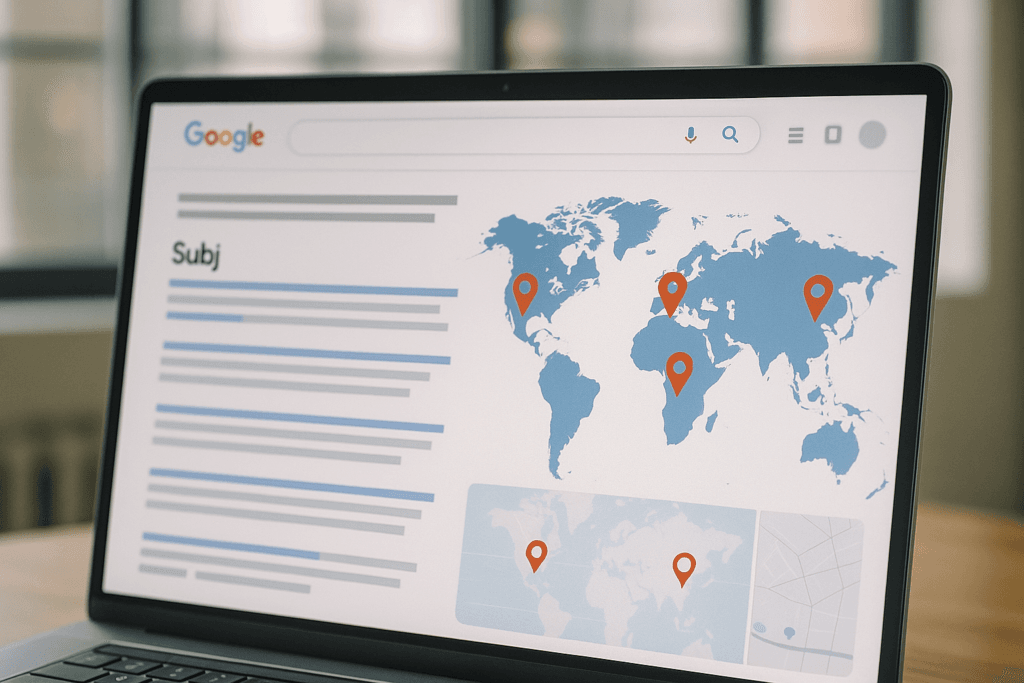
Picture a Leslieville skincare brand that sells beautifully in Canada, then opens up shipping to the United States and the UK. Sales trickle in, but the website barely shows up on Google outside Ontario. That gap is exactly where multi country SEO earns its keep. It is the practice of making one business rank properly in more than one country at the same time. This is part of our broader guide on The Small Business Guide to Ranking on Google in Canada. For the full overview, see The Small Business Guide to Ranking on Google in Canada.
I have watched too many owners assume Google is one global machine. It is not. Google shows different results to a shopper in Toronto than it does to one in Chicago or Manchester. Your job is to tell Google, clearly, which pages belong to which audience. Do that well and you compete locally in every market you serve. Do it badly and your pages fight each other for the same scraps.
What Multi Country SEO Actually Means for a Small Business
At its core, this is about signals. Google reads dozens of clues to decide where a page belongs. Your domain structure, your currency, your language, your server location, and your inbound links all whisper a story about who you serve. When those clues line up, Google trusts your pages in each region. When they contradict each other, Google gets confused and hedges by ranking you nowhere in particular.
Think of it like a storefront chain. A shop in Oakville and a shop in Boston can share a brand, but each needs its own address, its own hours, its own local reputation. Online, that means separate country-facing pages that speak to each market. You are not cloning content across borders. You are giving each audience a version built for them, with prices, spelling, and shipping details they recognize.
Choosing a Domain Structure That Google Understands
The first real decision in any multi country SEO plan is your URL structure. There are three common routes, and each carries a trade-off. You can use country-code domains like yourbrand.ca and yourbrand.co.uk. You can use subdomains such as us.yourbrand.com. Or you can use subfolders like yourbrand.com/us/ and yourbrand.com/uk/.
For most small and medium businesses, subfolders are the practical winner. They keep all your authority under one domain, so a strong Canadian site lends credibility to your new markets. Separate country domains split that authority, which means starting closer to scratch in each region. That is fine for a large brand with a big budget. For a growing business watching every dollar, subfolders stretch your effort further.
Here is a quick comparison to keep on your desk.
| Structure | Example | Best For | Main Drawback |
|---|---|---|---|
| Country domains | brand.ca / brand.co.uk | Big brands, strong local trust | Authority split, higher cost |
| Subdomains | us.brand.com | Distinct regional teams | Weaker authority sharing |
| Subfolders | brand.com/us/ | Most SMBs expanding abroad | Less local “signal” on its own |
Telling Google Who Each Page Is For With Hreflang
If you take one technical thing from this article, take hreflang tags. These are small snippets of code that tell Google which page serves which language and country. Without them, your Canadian and American pages can look like duplicates, and Google may show the wrong one to the wrong shopper. With them, a customer in Detroit sees your US page and a customer in Windsor sees your Canadian one.
Hreflang is fiddly. A single typo in a country code can break the whole set. I recommend testing your setup and reading the official rules directly from Google’s guidance on localized versions of pages. Get this right early. Fixing tangled hreflang months later is far more painful than setting it up cleanly from the start.
Why Copy-Pasting Content Across Countries Backfires
Here is the belief I most want to challenge. Many owners think ranking in a new country means duplicating their existing pages and swapping the currency symbol. It feels efficient. It almost never works well. Search behaviour, spelling, holidays, and buying triggers differ between markets, and identical content signals to Google that you have nothing new to offer that region.
A British shopper searches “trainers,” not “running shoes.” An American writes “color,” a Canadian writes “colour.” These are not cosmetic details. They are the exact phrases people type, and they decide whether you appear at all. Real localization means rewriting for how each market actually talks, then backing it with local reviews and links. That effort is the difference between a page that ranks and a page that just exists.
Multi Country SEO in Action: Three Real Patterns
A Junction-based furniture maker sold custom pieces across Canada and wanted the US Northeast next. Instead of one bloated page, they built a dedicated /us/ section with US shipping timelines, USD pricing, and hreflang tags mapping each page to its Canadian twin. Within about five months, they were pulling qualified American enquiries that previously never found them, and US traffic grew to roughly a third of their organic visits.
Contrast that with a Mississauga supplement retailer that took the shortcut. They cloned their Canadian store onto a .com, kept identical text, and hoped for the best. Google treated the pages as near-duplicates and buried both. After we separated the markets with proper localization and hreflang, their US organic sessions climbed steadily and the pages stopped cannibalizing each other within two quarters.
A third case: an Etobicoke software consultancy targeting the UK. They kept everything on subfolders and localized their case studies to British clients and British spelling. They also earned a handful of links from UK industry blogs. Cost per lead from British searches dropped about a third over six months, mostly because the pages finally matched local intent. None of these wins came from clever tricks. They came from clarity.
Local Signals Still Matter, Even Across Borders
Going international does not mean abandoning the local fundamentals. Each country market benefits from the same trust signals that power any regional ranking. Reviews, consistent business details, and locally relevant content all carry weight in every region you enter. If you have not nailed these at home yet, that is the place to start. Our breakdown of how local SEO helps small businesses win nearby customers applies directly, just repeated per market.
The same discipline that ranks you in Riverdale ranks you in Brooklyn. You need a real presence, real reviews, and content that answers real questions. Multi country SEO is not a separate universe. It is local SEO, executed carefully in several places at once, with the extra technical layer that keeps each market distinct in Google’s eyes.
Where This Advice Does Not Apply
Now the honest limitation. Not every business should go multi-country, and plenty jump too soon. If you cannot yet ship affordably, handle currency, manage returns, or provide support across time zones, ranking abroad only creates frustrated customers. SEO can pull demand you are not ready to serve. That is a fast way to earn bad reviews in a market you barely understand.
There is also the language question. If you expand into a market that speaks another language, machine translation alone will not cut it. A rough translation reads as untrustworthy and often ranks poorly. Sometimes the smarter move is to dominate one country completely before splitting your focus. Many Toronto businesses have more room to grow at home than they realize, which our list of practical tactics in proven SEO tips for Toronto businesses in 2026 makes clear.
A Simple Sequence to Start Multi Country SEO
When a client is genuinely ready, I walk them through the same order every time. Rushing the technical steps before the business steps is the most common mistake, so treat this as a checklist you can actually follow.
- Confirm you can operate in the new market: shipping, payment, returns, support.
- Pick your structure, usually subfolders, and map out which pages each country needs.
- Localize the content for spelling, currency, and how that market searches.
- Implement hreflang and test it before launch, not after.
- Build local trust with region-specific reviews, links, and business listings.
- Measure per country in Google Search Console so you know what is working where.
That last point matters more than most owners expect. Search Console lets you filter performance by country, so you can see exactly where you rank and where you stall. Without that split, you are flying blind across every border at once. If mapping this feels heavier than your team can carry, our digital marketing services for growing businesses exist precisely for this kind of expansion work.
It is worth remembering that SEO rarely works alone here. Entering a new country often pairs well with targeted advertising to test demand before you commit fully. Our thinking on paid ads and lead generation strategy shows how a short campaign can validate a market while your organic rankings build over months.
Getting Started Without Overcomplicating It
You do not need a perfect global setup on day one. Sound multi country SEO grows one market at a time, tested and proven before you add the next. Start with the country closest to your current success, the one where you already get orders or enquiries. Build that properly, learn from it, then repeat the playbook for the next region. Trying to launch five countries at once usually means doing all five poorly.
Keep your eye on the fundamentals in every market. Clear structure, honest localization, correct hreflang, and real local trust. Those four things carry more weight than any clever shortcut. Businesses that respect them tend to compound their gains, because each new market builds on a domain that is already trusted and organized.
Bringing It Together
Ranking across borders is not magic, and it is not out of reach for a small Toronto business. Multi country SEO simply asks you to be clear with Google about who each page serves, and to respect the differences between markets. Get the structure right, localize honestly, and prove you can actually deliver in each region. The businesses that win abroad are rarely the biggest. They are the ones who did the unglamorous groundwork properly.
For the wider picture, see our full guide on The Small Business Guide to Ranking on Google in Canada. If you are weighing an international expansion and want a straight answer on whether you are ready, book a conversation with our team and we will map it out with you.