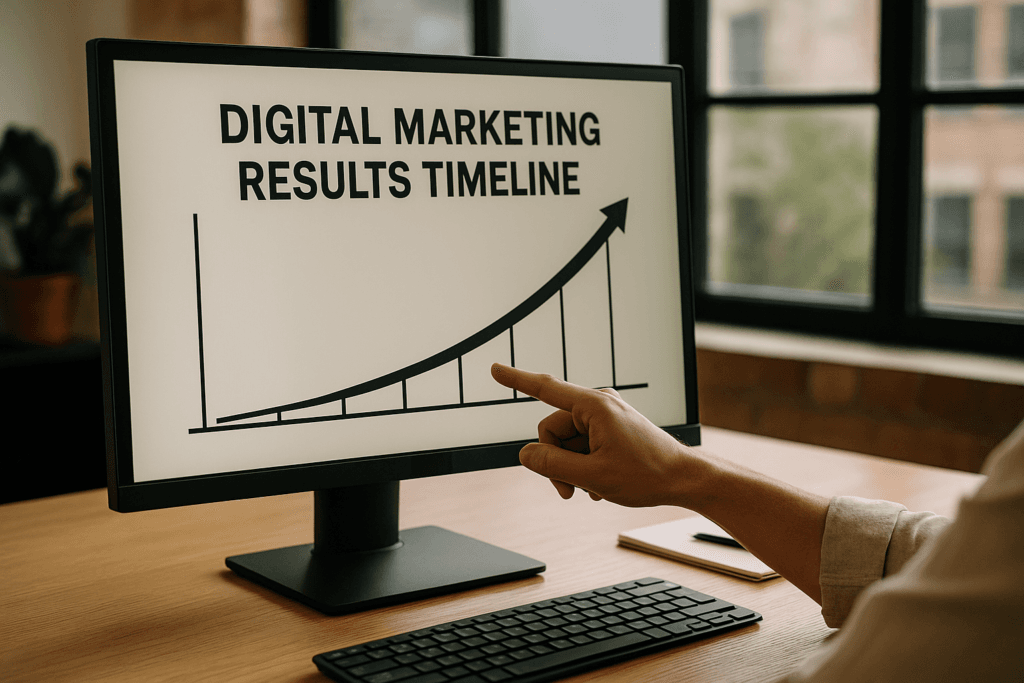
When will this start working?” I hear that question in almost every first meeting. It’s fair. You’re spending money, and you want to know when it turns into customers. The honest answer is that the digital marketing results timeline depends heavily on which channel you’re using and how competitive your market is. This is part of our broader guide on Digital Marketing Strategy for Small Businesses. For the full overview, see Digital Marketing Strategy for Small Businesses.
Let me set expectations before we go further. Marketing is not a light switch. It’s closer to planting a garden while also selling produce at a stand out front. Some things sell today. Other things need months in the soil before they bear fruit. The trick is knowing which is which, so you don’t rip out the seeds before they sprout.
Why the digital marketing results timeline varies so much
Two businesses can run identical campaigns and see wildly different timelines. A plumber in Etobicoke with three local competitors will rank faster than a clothing brand fighting thousands of stores online. Your starting point matters too. A business with an established website and reviews has a head start over one launching from zero.
Budget changes the pace as well. Someone spending $500 a month on ads reaches fewer people than someone spending $5,000. That’s obvious, but owners forget it when comparing themselves to bigger competitors. The channel you pick is the single biggest factor in how quickly you’ll see movement, so let’s break the main ones down honestly.
A realistic digital marketing results timeline by channel
Different tactics run on different clocks. Some show life within days. Others take the better part of a year before they pull real weight. Here’s a rough guide I share with clients, based on what I’ve actually seen work in the GTA.
| Channel | First signs of life | Meaningful results |
|---|---|---|
| Google Ads / paid search | 3–7 days | 4–8 weeks |
| Social media ads (Meta) | 1–2 weeks | 6–10 weeks |
| Local SEO / Google Business | 4–8 weeks | 3–6 months |
| Organic SEO (competitive) | 3–4 months | 6–12 months |
| Content marketing / blogging | 2–3 months | 6–12 months |
| Email marketing | 1–2 weeks | 2–4 months |
Treat those ranges as weather, not a calendar appointment. They shift with your market and effort. Paid channels give you the fastest feedback because you’re buying attention directly. Organic channels take longer because you’re earning it, and earning trust from Google is slower than paying for a spot.
The paid ads clock: fast feedback, but not instant profit
Paid search is the quickest way to appear in front of buyers. Your ads can go live in a day. But going live and being profitable are two very different things. The first few weeks are about learning, not winning. The platform is testing who responds and gathering data you’ll need later.
I worked with an auto repair shop in the Junction that expected phone calls the first weekend. Situation: they’d launched cold, no history, no tracking. Action: we spent the first three weeks tightening keywords and killing wasted clicks. Outcome: by week seven, their cost per booked appointment dropped about 40 percent and calls became steady. The early “quiet” period wasn’t failure. It was tuition.
If you run paid campaigns in a competitive professional field, patience matters even more. Our breakdown of what actually works with Google Ads for Toronto law firms shows how expensive clicks demand a longer optimization runway before the math turns positive.
The SEO clock: slow to start, hard to stop
Search engine optimization is where owners lose their nerve. For the first couple of months, it feels like nothing is happening. You’re publishing, tweaking, waiting. Then somewhere around month four or five, traffic starts climbing, and it keeps climbing without you feeding it more ad money.
An e-commerce store selling home goods came to us frustrated after “trying SEO” for six weeks. That’s not trying SEO. That’s barely warming up. Once we committed to a proper twelve-week content and technical plan, organic sessions grew steadily and their reliance on paid traffic eased. If you sell online, our guide on SEO strategy for Canadian e-commerce stores walks through why product and category pages need their own timeline logic.
Google’s own documentation is refreshingly blunt about this. Their SEO starter guide from Google Search notes that changes can take months to show, and that there are no shortcuts to lasting rankings. When the company that owns the results tells you it’s slow, believe them.
The contrarian bit: faster results can cost you more
Here’s something most agencies won’t say out loud. The fastest results are often the most expensive per customer over time. Paid ads deliver quick wins, but the moment you stop paying, the traffic stops. It’s rented attention. You never build equity.
SEO and content are slow, but they compound. A blog post that ranks can bring leads for years at essentially no extra cost. So the “slow” channel is frequently the cheaper one when you zoom out. Chasing speed alone is how businesses end up trapped, forever renting customers because they never planted anything they own. The smart play is running both: ads to eat today, SEO to eat next year.
Real timelines from real businesses
A wellness clinic in Leslieville wanted to fill a new practitioner’s schedule. We layered local SEO with a modest Meta ad budget. Bookings from ads appeared within two weeks. The organic map rankings took about four months. By month five, roughly 60 percent of new patients came from search they weren’t paying for per click.
Contrast that with a Brampton retailer who only ran ads. Sales came fast, within the first month. But eighteen months in, they were still spending the same amount every month with no growing base of free traffic. They got speed and paid for it, over and over. Neither approach is wrong. They just sit at different points on the digital marketing results timeline, and you should choose with your eyes open.
One more, quick. A trades contractor in Weston did nothing but claim and optimize his Google Business Profile and gather reviews. No ads at all. Calls from the map pack climbed noticeably over three months. Sometimes the cheapest lever is also one of the faster ones. It just isn’t glamorous.
Where the usual advice breaks down
These timelines assume you’re actually executing well. If your website is slow, confusing, or doesn’t convert, no channel will hit its schedule. Traffic that lands on a broken page is just expensive noise. Fix the foundation first, or every timeline stretches longer than it should.
There’s also a limit to how much SEO helps certain businesses. If you sell a one-time service to a tiny local audience, ranking for search terms nobody types won’t do much. A niche B2B consultant might get more from LinkedIn and referrals than months of blogging. Match the channel to how your customers actually look for you, not to what’s trendy. When the fit is off, the timeline stops mattering because the channel itself is wrong.
How to read your own digital marketing results timeline
You don’t need a dashboard degree to track progress. Watch a few honest signals in order. First, impressions and reach, meaning are you being seen at all. Second, clicks and traffic, meaning are people interested enough to visit. Third, leads and sales, the only number that pays the bills.
Those three appear in sequence, never all at once. If you’re getting seen but not clicked, your message or offer is weak. If you’re clicked but not converting, your website or follow-up is the leak. Reading the timeline this way tells you what to fix instead of just panicking that “it isn’t working.” Most owners quit at the stage right before results, because they’re measuring the wrong thing at the wrong moment.
If you’d rather not decode all this alone, this is exactly the kind of thing our digital marketing services team maps out for clients from day one, so you know what to expect at week two versus month six. Setting that expectation early prevents the panic that kills good campaigns.
Where to start if you want a sane digital marketing results timeline
Start with the goal, then pick the channel that matches your patience and cash. Need customers this quarter to keep the lights on? Lead with paid ads and email. Building something you want to own for years? Commit to SEO and content, and don’t touch it for at least six months. Most GTA businesses need a blend, weighted toward whichever pressure is louder right now.
Set one review point at 30 days and another at 90. At 30 days you’re checking the machine is running, not judging profit. At 90 days you’re judging direction. That rhythm keeps you from both panic-quitting and endless coasting. A realistic digital marketing results timeline is really just a set of honest checkpoints, agreed on before you start, so nobody moves the goalposts mid-game.
The bottom line on your digital marketing results timeline
Digital marketing works, but it works on its own clock, and that clock is different for every channel. Paid ads sprint. SEO runs a marathon. Content plays the long game and pays you back for years. The businesses that win aren’t the ones who found a shortcut. They’re the ones who understood the digital marketing results timeline, set fair expectations, and stayed in past the awkward middle where results are quietly building but not yet visible.
For the wider picture, see our full guide on Digital Marketing Strategy for Small Businesses. It connects these timelines to the bigger plan.
Curious how fast your own business could realistically move? Tell us your goal and your market, and we’ll give you an honest timeline before you spend a dollar. Reach out through our contact page to start a straight conversation.