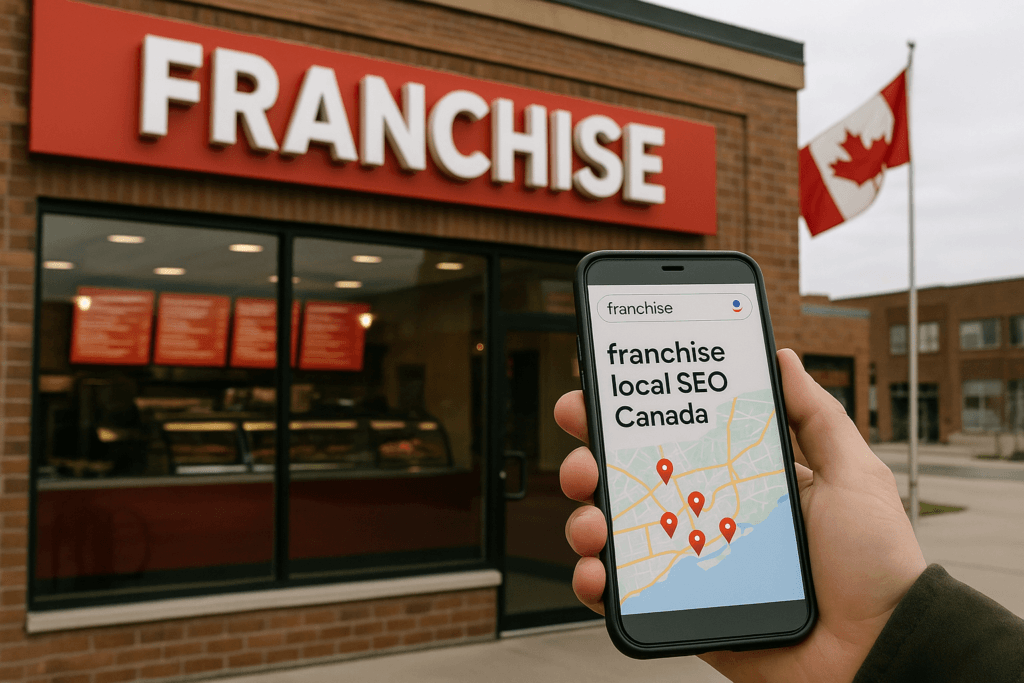
Picture two coffee franchises three blocks apart in Leslieville. Same brand, same menu, same signage. One shows up first when someone searches “coffee near me.” The other is buried on page two. Nothing about the product explains the gap. The difference is franchise local SEO Canada done well versus done as an afterthought. This is part of our broader guide on The Small Business Guide to Ranking on Google in Canada. For the full overview, see The Small Business Guide to Ranking on Google in Canada.
I have sat with franchise owners across the GTA who assume the head office handles all of this. Sometimes it does. Often it does not. And even when corporate runs a national site, individual locations still compete in their own neighbourhoods. That local layer is where deals are won or lost.
Why franchise local SEO Canada works differently than a single-shop strategy
A one-location business has one job: rank in its own area. A franchise has a harder puzzle. You have multiple locations, often in overlapping markets, all sharing one brand name. Google has to figure out which location to show for which searcher. If your setup confuses that logic, your locations start cannibalizing each other.
The other wrinkle is control. Franchisees rarely own the master website. You might not be able to change the national domain. But you can absolutely control your Google Business Profile, your local citations, and the content that mentions your specific address. That local footprint is what moves the needle in your postal code.
Canada adds its own quirks too. Bilingual markets in parts of the country. Postal code formats that differ from the US. Regional search behaviour where “washroom” beats “restroom” and people search “the Junction” not “West Toronto.” National franchise templates built for American markets often miss these details entirely.
The one profile that decides most of your local visibility
If I could only fix one thing for a franchise location, it would be the Google Business Profile. It is the single biggest lever in local search, and it is often the most neglected. Each location needs its own claimed, verified profile with an accurate address, local phone number, and correct category.
Get the details right and keep them consistent. The name should match your storefront signage. The category should be specific, not generic. Hours must be accurate, including holiday hours, because nothing tanks trust faster than a customer driving to a closed store. You can review the official rules directly through Google Business Profile Help before you make changes.
Photos matter more than owners expect. Real photos of your actual location, your team, and your products beat stock images every time. A Mississauga auto shop I worked with swapped generic images for real bay and staff photos. Their profile views climbed noticeably within two months, and direction requests followed.
Reviews are the other half of this. Ask every satisfied customer, respond to every review, and never ignore the negative ones. A steady stream of recent, genuine reviews signals to Google that the location is active and trusted. This same profile-first thinking applies to any local operator, which we cover in depth in our guide to local SEO fundamentals for small business.
Building location pages that Google and customers both like
Here is where most franchise sites fall apart. They spin up one location page per store and copy the exact same text into all of them, swapping only the address. Google reads that as duplicate content and ignores most of it. A page for your Oakville branch should read differently than your Brampton one.
Each location page needs unique content. Mention the neighbourhood, nearby landmarks, parking, transit access, and the specific services that location offers. Add the address, embedded map, local phone number, and hours. Write a few paragraphs that a real human from that area would recognize as true.
Think of each page as a mini storefront online. If someone in Riverdale lands on your Riverdale page, they should feel like it was written for them, not for a national audience. That relevance is what earns local rankings and clicks.
A dental franchise with four GTA locations tried this after months of flat traffic. Situation: identical location pages, all competing for the same terms. Action: we rewrote each page with neighbourhood-specific detail, local staff bios, and area-relevant FAQs. Outcome: their weakest location moved from page three to the top of page one for its core term in about five months, and new patient calls to that branch roughly doubled.
Keeping your NAP consistent across every location
NAP means Name, Address, Phone number. It sounds trivial. It is not. When your Weston location is listed as “123 Main St” on Google, “123 Main Street” on Yelp, and “123 Main St. Unit 4” on your own site, search engines get nervous. Inconsistent details erode the confidence Google has in your data.
Franchises multiply this problem. Every new location means another set of citations to manage across dozens of directories. Old data lingers when locations close or move. I have seen franchises lose visibility simply because a closed location still lived on twenty stale listings, splitting the brand’s authority.
Build a master spreadsheet. One row per location, with the exact name, address, phone, hours, and profile URLs. Every listing should match that source of truth, character for character. Audit it quarterly. This is unglamorous work, but consistency is the quiet foundation that holds everything else up.
A copy-and-use checklist for each franchise location
Run every location through this before you worry about anything fancier. If a store fails three or more of these, that store is leaking local visibility right now.
- Profile: Google Business Profile claimed, verified, and correctly categorized.
- NAP: Name, address, and phone identical across Google, your site, and top directories.
- Local number: A local area code number, not a shared national line.
- Location page: A unique, neighbourhood-specific page on the main site.
- Reviews: At least a steady trickle of fresh reviews with owner responses.
- Photos: Ten or more real, recent photos of the actual location.
- Citations: Listed accurately on Yelp, Apple Maps, Bing, and local directories.
- Schema: LocalBusiness structured data on the location page.
Print it. Walk through it store by store. It is boring and it works, which describes most of the local SEO that actually earns money.
The contrarian truth about national brand pages
Franchisees often believe corporate marketing carries their local rankings. Here is where I push back. A powerful national brand helps far less locally than people assume. Google’s local algorithm heavily weights proximity, individual profile signals, and location-specific relevance. Your national domain authority barely factors into “near me” searches.
I have watched small independent shops outrank national franchise locations in the same neighbourhood. Not because they had bigger budgets. Because they owned their Google Business Profile, gathered reviews weekly, and posted local updates. The franchise assumed the brand did the work, so nobody did it.
That is the uncomfortable lesson. Being part of a recognized franchise is an advantage in trust, not automatically in local search. The location that treats its own profile like a living asset wins the neighbourhood, brand power or not.
Where franchise local SEO Canada tactics stop working
This is not a cure for a bad location or a weak offer. If your store sits in a dead retail strip with no foot traffic and prices nobody wants, ranking first for local searches will not save it. SEO amplifies a working business. It does not manufacture demand that isn’t there.
There is also a governance limit. If corporate forbids you from editing location pages or managing your own profile, your hands are partly tied. In those cases, the real fix is a conversation with head office, not another tactic. Push for local control where you can, because the franchisee closest to the customer usually knows the market best.
And in very small towns with little search volume, local SEO delivers less. When only a handful of people search your category monthly, word of mouth and community presence may matter more than rankings. Match the effort to the size of the prize.
Turning local visibility into actual foot traffic
Rankings are a means, not the goal. The point is customers walking in or picking up the phone. Once a location ranks, the profile becomes a conversion tool. Clear photos, honest hours, quick review responses, and a simple booking or call link turn a search into a visit.
A wellness franchise location in Etobicoke learned this the hard way. It ranked well but had no call-to-action and slow review replies. We added a booking link to the profile, set up a routine of same-day review responses, and posted weekly offers. Within four months, phone bookings from Google rose sharply, and the location’s cost per new client dropped roughly a third.
Local search also feeds the rest of your marketing. Strong profiles improve ad quality, and consistent data helps every channel work harder together. For the broader tactical playbook, our roundup on how Toronto businesses can win more customers through smarter SEO pairs well with this location-level work. If pulling all of it together across many stores feels like too much, our team handles this through our digital marketing services for growing businesses.
Where to start with franchise local SEO Canada this week
Do not try to fix twenty locations at once. Start with your worst performer or your newest one. Claim and verify its Google Business Profile first. Fix the NAP across your top five directories. Rewrite its location page with real neighbourhood detail. Ask ten recent customers for reviews.
Then measure for a month before scaling. Watch profile views, direction requests, and calls. Once you see the pattern working on one location, roll the same steps out to the next. Franchise local SEO Canada rewards consistency and patience, not a single heroic push. The owners who win treat it as a monthly habit, not a one-time project.
If you also run paid campaigns per location, tie them to this local foundation. Strong local signals lower ad costs and lift relevance. Our thinking on paid ads and lead generation for local businesses connects directly to the groundwork above.
Bringing it together
Franchise local SEO Canada is less about clever tricks and more about disciplined ownership of every location’s local presence. Claim the profiles. Keep the data clean. Write pages that speak to real neighbourhoods. Gather reviews steadily. Do that across your locations and you stop leaving nearby customers to your competitors. For the wider picture, see our full guide on The Small Business Guide to Ranking on Google in Canada.
Which of your locations is quietly losing its neighbourhood right now? If you are not sure, that is usually the one to check first. When you want a hand mapping out a plan that fits your specific franchise, reach out to the Sonamax team for a straight conversation about your locations.