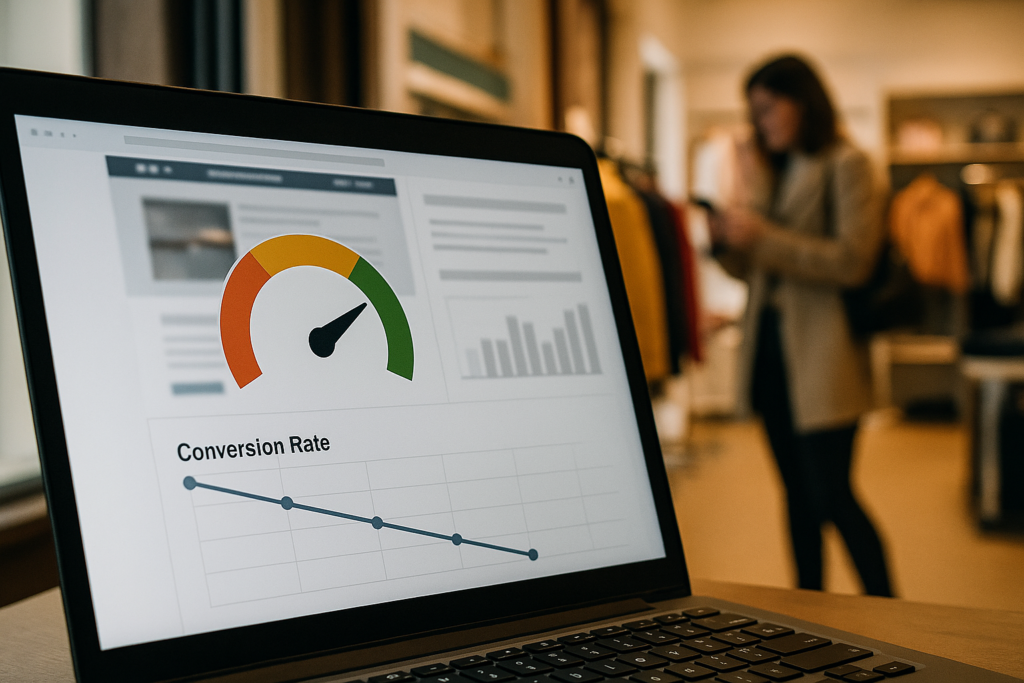
Three seconds. That’s roughly how long a visitor waits before they start thinking about leaving your site. Push past that and you’re not losing patience, you’re losing money. The relationship between website speed and conversions is one of the most underrated levers a Toronto business has, and most owners never touch it. This is part of our broader guide on Branding & Web Strategy for Growth. For the full overview, see Branding & Web Strategy for Growth.
I’ve sat with dozens of business owners who spend thousands driving traffic to a site that quietly bleeds visitors before the page even finishes loading. They fixate on the headline, the logo, the colour of the button. Meanwhile the real leak is invisible. A slow site is like a shop with a jammed front door. People show up, they can’t get in, and they walk to the place next door.
Why Website Speed and Conversions Move Together
Speed builds trust before a single word is read. When a page snaps into view, it signals a business that has its act together. When it stalls, visitors assume the rest of the experience will be just as clunky. That gut reaction happens in a fraction of a second, long before anyone reads your carefully written copy.
The data backs this up hard. Google’s research shows that as page load time goes from one to three seconds, the probability of a bounce jumps by 32 percent. Stretch it to five seconds and that probability climbs past 90 percent. You can read the numbers straight from the source in Google’s own breakdown of why speed matters. Every second you shave off is a second you’re not handing to your competitor.
There’s also a compounding effect people miss. Slow pages hurt your search rankings, which means less traffic arrives in the first place. Then the traffic that does arrive converts worse. So speed quietly taxes you twice. Fixing it isn’t a nice-to-have. It’s often the cheapest growth you’ll ever buy.
The Real Cost of a Slow Page
Let me put a number to it. Imagine a Leslieville home goods shop doing 40,000 dollars a month in online orders. If their site loads a full second faster and conversions lift by even 7 percent, that’s about 2,800 dollars a month. Over a year, that’s more than 33,000 dollars from a technical fix that took a weekend. No new ads. No new content. Just a faster door.
Here’s a quick way to gauge your own exposure. Use this rough formula before you decide speed doesn’t matter for you:
- Monthly visitors × current conversion rate = current sales
- Every 1 second faster ≈ 5 to 10 percent conversion lift (varies by industry)
- Current sales × estimated lift = money left on the table
Plug in your own numbers. Most owners are surprised. The gap between what they’re earning and what a faster site would earn is usually bigger than their entire monthly marketing budget.
Where Speed Actually Gets Lost
Slowness rarely comes from one big villain. It’s usually death by a thousand cuts. Oversized images are the most common culprit I see. Someone uploads a photo straight off their phone at 6,000 pixels wide, and the browser has to shrink it every single time the page loads. That one habit can double your load time on its own.
After images, the usual suspects are too many plugins, bloated page builders, and cheap shared hosting that buckles under traffic. A restaurant in the Junction once had 38 active plugins on a five-page site. We disabled 22 of them and load time dropped from 6 seconds to under 2. Their online reservation completions went up noticeably within the first month, because people stopped abandoning the booking form mid-way.
Mobile is where the real damage hides. Most of your Toronto traffic is on a phone, often on a spotty connection somewhere on the TTC. A page that feels fine on your office desktop can crawl on a mid-range Android. If you only ever test on your own laptop, you’re grading your own homework.
The Contrarian Truth About Speed and Design
Here’s something that annoys a lot of designers. A plain, fast website beats a beautiful, slow one almost every time. I’ve watched gorgeous, animation-heavy sites lose to plain competitors because the plain site loaded instantly and got out of the customer’s way. Speed is a feature customers feel even if they can’t name it.
This connects directly to how your brand shows up. A polished visual identity matters, but only if people stick around long enough to see it. When we help clients with their brand identity and business design work, we treat performance as part of the brand, not separate from it. A brand that loads slowly reads as a brand that doesn’t care.
That said, don’t swing to the other extreme and strip your site bare. The goal isn’t the fastest possible site. It’s the fastest site that still tells your story and moves people to act. Speed serves the sale. It doesn’t replace it.
Practical Steps to Improve Website Speed and Conversions
You don’t need to be technical to start. The first move is measurement. Run your site through a free tool and get an honest baseline before you touch anything. Here’s the sequence I give clients who want to tackle this themselves:
- Test first. Run your top three pages through Google’s PageSpeed Insights tool on both mobile and desktop.
- Fix images. Compress and resize every image. This alone often cuts load time in half.
- Cut the bloat. Delete plugins and scripts you don’t actively use.
- Upgrade hosting. Cheap shared hosting is false economy. Better hosting pays for itself.
- Enable caching. Let returning visitors load your pages from a saved copy.
- Retest. Measure again and note the change in real numbers.
Work through that list in order and most sites see a real jump. A Mississauga auto detailing shop followed exactly these steps over two weekends. Their quote-request form submissions rose by roughly a third, and their cost per lead on paid ads dropped because more clicks actually turned into inquiries. Same traffic, same ad spend, better door.
If any of this feels over your head, that’s normal. This is where a proper build matters. Our Toronto website development team handles the technical heavy lifting so speed is baked in from the start rather than patched on later. Building it fast the first time is always cheaper than fixing it slow later.
When Speed Isn’t Your Real Problem
Now for the honest part. Speed is not a magic wand. If your offer is weak, your pricing is off, or nobody’s searching for what you sell, a faster site just delivers your bad message more efficiently. I’ve seen owners obsess over shaving milliseconds while their actual problem was a confusing headline nobody understood.
Speed matters most when you already have traffic that’s leaving. If you’re getting hundreds of visitors and few sales, speed is a prime suspect. But if you’re getting ten visitors a month, your problem is reach, not load time. Fix the leak that’s actually draining the boat. Sometimes that’s speed, sometimes it’s your entire go-to-market approach, which we cover more broadly in our rundown of practical ways to grow a small business.
There’s also a point of diminishing returns. Going from 8 seconds to 2 is transformative. Going from 2 seconds to 1.5 barely moves the needle for most businesses. Chase the big wins first and don’t let a developer talk you into perfectionism you’ll never notice at the register.
How Speed Feeds the Rest of Your Marketing
A fast site makes every other dollar work harder. Your paid ads convert better, so your cost per acquisition drops. Your SEO improves, so you climb the rankings without writing a single new blog post. If you’re running campaigns, this ties directly into your broader paid ads and lead generation strategy, because speed is what turns an expensive click into an actual customer.
Think of speed as the foundation under everything else. You can pour money into traffic, design, and copy, but if the foundation is cracked, it all leaks out the bottom. A Beaches wellness studio learned this the hard way. They doubled their ad budget for three months and saw almost no lift, because their booking page took seven seconds to load on mobile. We fixed the page before touching the budget, and the same ads finally started paying.
Where to Start With Website Speed and Conversions
Start with a single number: how fast does your most important page load on a phone? Not your homepage necessarily, but the page where people actually buy or book. That’s the page carrying your revenue. Everything else is secondary until that one is fast.
Once you know your baseline, tackle the biggest, cheapest wins first. Images and hosting usually give you 80 percent of the improvement for 20 percent of the effort. Don’t try to fix everything in one go. The link between website speed and conversions rewards steady progress, not a single heroic overhaul. Measure, fix one thing, measure again, and let the numbers guide your next move.
Keep a simple log as you go. Note your load time and conversion rate before and after each change. When you can see the dollar impact of a two-second improvement, this stops feeling like abstract tech work and starts feeling like the growth investment it actually is.
The Bottom Line on Speed and Sales
Your website is a salesperson that works every hour of the day. A slow site is a salesperson who shows up late, mumbles, and lets customers wander off. The connection between website speed and conversions isn’t a technical footnote. It’s one of the most direct levers you have on revenue, and it’s usually cheaper to pull than any other. For the wider picture, see our full guide on Branding & Web Strategy for Growth.
So here’s my challenge to you. Pull up your most important page on your phone right now and count the seconds out loud. If you got past three, you already know there’s money sitting on the table. When you’re ready to close that gap, book a quick chat with the Sonamax team and we’ll help you find out exactly what your speed is costing you.