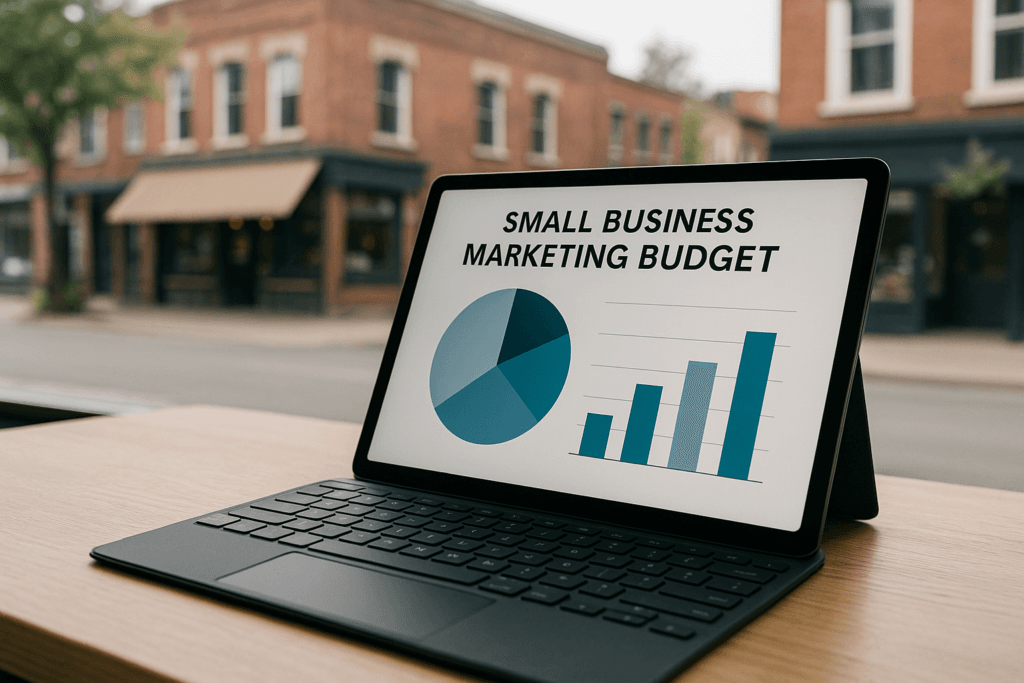
Ask ten Toronto business owners what they spend on marketing and you’ll get ten different answers. Some spend nothing and hope word of mouth carries them. Others throw money at ads and pray. The truth is that a smart small business marketing budget has less to do with how much you spend and more to do with where you point it. This is part of our broader guide on Digital Marketing Strategy for Small Businesses. For the full overview, see Digital Marketing Strategy for Small Businesses.
I’ve sat across from owners in Leslieville cafes and Etobicoke warehouses who were convinced they needed a five-figure budget to compete. They didn’t. What they needed was a plan that matched their money to their customers. That’s the whole game. Spend follows strategy, not the other way around.
What a small business marketing budget really needs to cover
People hear “budget” and picture ad spend. That’s a fraction of it. A real marketing budget covers the ad money, yes, but also the tools, the content, the website upkeep, and the time someone spends managing all of it. Forget the time cost and you’ll underestimate everything by half.
A useful benchmark for Canadian small businesses is spending between 5 and 10 percent of revenue on marketing. Newer businesses trying to build awareness often land closer to 10 or 12. Established shops with steady repeat customers can sit at 5. These aren’t laws. They’re guardrails to keep you from spending nothing or bleeding cash on things that don’t move the needle.
Here’s a simple split I hand to owners who are starting from scratch:
- 40% — the channel that already brings you customers (double down here)
- 30% — your website and content, the assets you own forever
- 20% — testing one new channel per quarter
- 10% — tools, tracking, and the boring plumbing
Adjust the percentages to fit reality. The point is that every dollar has a job. A small business marketing budget without categories is just a number you feel guilty about.
The free work most owners skip before spending a cent
Before you pay for a single click, there’s groundwork that costs nothing but time. A fully filled-out Google Business Profile does more for a local shop than most people believe. It’s the difference between showing up when someone nearby searches for what you sell and staying invisible. You can build and optimize yours through Google’s free Business Profile tool, and it takes an afternoon.
Reviews fall into the same bucket. Asking happy customers to leave a review costs nothing and quietly builds trust that no ad can buy. A Riverdale bakery I worked with went from nine reviews to over sixty in three months just by printing a small card with a QR code near the till. Their weekend foot traffic climbed noticeably, and they hadn’t spent a dollar on ads yet.
The lesson holds across industries. If you run a service business, your first marketing money should never go to ads while your profile sits half-empty. Fix the free stuff first. It makes every paid dollar work harder later, because people who click your ad still check your reviews before they call.
Where a small business marketing budget usually gets wasted
The most common leak I see isn’t overspending. It’s spreading too thin. An owner runs a bit of Facebook, dabbles in Google Ads, boosts a post here and there, maybe pays for a directory listing. Nothing gets enough fuel to catch fire. Three hundred dollars split five ways teaches you nothing about any single channel.
Chasing every trend burns money too. A wellness studio in the Junction once told me they’d spent months producing short videos because everyone said video was the future. The videos got views. They booked almost no clients. Their actual customers were finding them through local search, not a feed. We shifted the effort there and their bookings roughly doubled over four months on the same monthly spend.
The contrarian bit that ruffles feathers: cheaper is not always smarter. Owners obsess over the lowest cost per click or the free tool. But a channel that costs more per lead while closing far more sales is the cheaper option in the end. Judge spending by what walks through the door, not by what looks affordable on a dashboard.
Matching your budget to your actual business
A trades business and a restaurant should not spend money the same way. That sounds obvious, yet I watch people copy tactics from businesses nothing like their own. What works depends on how your customers decide to buy and how urgently they need you.
Contractors and home-service trades live and die by local search and reviews, because people hire when a pipe bursts or a roof leaks. If that’s your world, put your money where urgent buyers look. Our breakdown of digital marketing for Toronto contractors walks through exactly how that spending should be shaped.
Restaurants play a different game. Discovery, photos, menus, and search visibility drive most of the decision. A great plate of food means nothing if nobody can find your hours or see your patio. If you run a food spot, our guide to restaurant SEO in Toronto shows where the budget should land first.
The principle underneath both: study how your own customers already find you. Ask five recent ones how they discovered you. The answers point straight at where your money belongs. This kind of matching is exactly where a strong digital marketing strategy for local businesses earns its keep, because generic advice ignores the shape of your specific market.
A simple sequence for building a small business marketing budget
When an owner asks me where to begin, I give them an order, not a wish list. Doing things in sequence stops the money from scattering. Here’s the path I’d walk a new client down.
Start by nailing down your numbers. What’s a customer worth to you over a year? If a client spends $2,000 and you keep them two years, that’s $4,000. Suddenly a $60 lead cost looks like a bargain, not an expense. Without this figure, every spending decision is a guess.
Next, claim and polish every free asset. Google Business Profile, your website basics, your reviews. Then pick one paid channel and fund it properly for at least ninety days. One channel, real money, enough time to learn something true. Only after that channel proves itself do you add a second. This slow build feels boring, but it’s how a small business marketing budget compounds instead of evaporates.
Track one thing above all: cost per booked customer. Not clicks, not likes, not reach. An automotive shop in Mississauga cut wasted spend by watching this single number. They killed a campaign that looked busy but delivered nothing, moved that money to search, and their cost per new customer dropped about a third within a quarter.
When spending less is the wrong move
I’m the last person to tell you money solves marketing. But there’s an honest limit to the frugal approach, and pretending otherwise does you no favours. If you’re in a crowded, competitive market, an underfunded budget just guarantees you stay invisible. A new beauty salon opening near three established competitors in Liberty Village can’t tiptoe in on fifty dollars a month.
Sometimes the right call is to spend more, faster, to establish a foothold before a competitor locks up the local search results. In those cases, being too careful costs you the market. Frugal marketing works beautifully when you have some existing traction to amplify. It works poorly when you’re trying to break into a saturated space cold. Know which situation you’re actually in.
There’s also the automation angle worth weighing. As tools get smarter, a modest budget stretches further than it did five years ago. If that interests you, our thinking on AI-powered marketing for small businesses covers how leaner operations are getting more from less.
Where to start with your small business marketing budget
Don’t build a spreadsheet first. Build clarity first. Before you allocate a dollar, answer three questions honestly, and write the answers where you’ll see them. What is a customer worth to you over their lifetime? Which channel already brings you the most business today? What’s the one thing a new customer needs to see before they trust you enough to buy?
With those three answers in hand, a small business marketing budget almost writes itself. You fund the channel that works, protect the assets you own, and set aside a small pot to test. It’s not complicated. It just requires resisting the urge to do everything at once. For grounding on how the pieces fit, HubSpot’s overview of marketing costs and budgeting is a solid, jargon-free reference.
Give it two full quarters before you judge results. Marketing is a slow fire, not a light switch. The owners who win are rarely the ones who spent the most. They’re the ones who stayed consistent while everyone around them kept jumping to the next shiny thing.
Bringing it together
A good small business marketing budget isn’t about restraint or splurging. It’s about aiming. Point steady, funded effort at the places your real customers already are, protect what you own, and measure by customers gained rather than dashboard vanity. Do that and even a modest budget can hold its own against far bigger spenders. For the wider picture, see our full guide on Digital Marketing Strategy for Small Businesses.
Still unsure how much your business should be spending, or where that money would work hardest? Send us a note and tell us what you’re working with — we’ll give you a straight read on where your dollars belong.